





It Won't Look Like the Movies
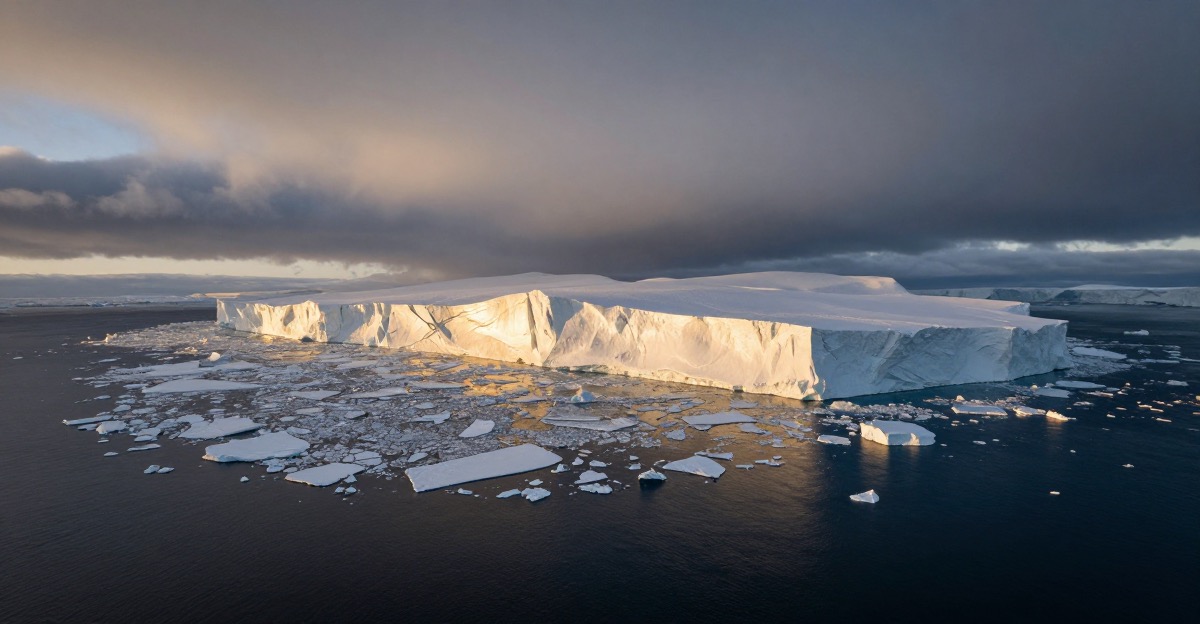
When people hear "ice-free Arctic," they picture open blue water where polar bears used to be. A clean, sad image. Easy to understand.
That's not what's coming.
What's coming is a 9.4-million-square-kilometre ocean that currently acts as a giant white mirror suddenly becoming the planet's largest solar heat sink. An ocean that has been covered in reflective ice for longer than human civilization has existed, absorbing six to fifteen times more solar energy than it did before. A body of water surrounded by permafrost that will start thawing from both directions -- from above by warmer air, from below by warmer currents -- releasing methane that was locked in place since the Pleistocene.
That's the part the headline doesn't capture. "Ice-free" isn't just an absence. It's a phase change. And phase changes don't negotiate.
Why Arctic Ice Exists (and Why It's Stopping)
The Arctic Ocean freezes because of something called the halocline -- a layer of cold, low-salinity water that sits on top of warmer, saltier Atlantic water underneath. Fresh water from rivers and ice melt keeps that surface layer diluted. Fresh water freezes at a higher temperature than salt water. So even though there's warm Atlantic water below, the fresh surface layer freezes first and forms a cap.
Think of it as a cold blanket floating on a warm bath. As long as the blanket stays in place, the warm water below can't reach the surface.
That blanket is coming apart.
Atlantification
Between 2011 and 2016, the Barents and Kara seas lost their halocline stratification entirely. The fresh surface layer that kept those waters freezing simply disappeared. Warm Atlantic water moved in from the south, displacing the Arctic water that had maintained the ice cycle for millennia. This process -- scientists call it "Atlantification" -- is spreading east and north.
Once the halocline destabilizes in a region, ice stops forming there reliably. It's not that the temperatures are too warm for ice. It's that the water column itself has changed. The architecture that made freezing possible is gone.
The Numbers That Matter
Between 1958 and 2018, average ice thickness at the September minimum dropped by two metres. That's a 66% reduction. Not at the edges. Across the basin.
Multiyear ice -- the thick, old stuff that survives summer melt and forms the structural backbone of the ice pack -- went from being the dominant ice type to roughly 30% of all Arctic ice by 2017. That's a 50% decline from just 2002. Fifteen years to lose half the old ice.
The Albedo Feedback Loop
This matters because of albedo. Ice reflects 50 to 70% of incoming solar radiation back into space. Open water reflects about 6%. Every square kilometre of ice that disappears becomes a square kilometre of dark ocean that absorbs almost all the energy hitting it. That absorbed energy warms the water. Warmer water melts more ice. More open water absorbs more energy.
This is not a metaphor for a feedback loop. It is a feedback loop. It's running right now, and it's accelerating.
Current modelling places an ice-free summer Arctic before 2050. Some models say before 2035. The consensus has been moving the date closer for twenty years running, which tells you something about how well we've been predicting this.
What 2045 Means for Shipping and Military
An ice-free or near-ice-free Arctic Ocean opens the Northwest Passage and the Northern Sea Route as viable commercial shipping lanes. Rotterdam to Tokyo through the Suez Canal is about 21,000 kilometres. Through the Arctic, it's roughly 13,000. That's a 40% reduction in distance, fuel, time, and piracy risk.
Countries are already positioning for this. Russia has been building military bases along its Arctic coast for a decade. China declared itself a "near-Arctic state" in 2018 -- a geographic claim that would be funny if they weren't backing it with icebreakers and investment. Canada claims the Northwest Passage as internal waters. The United States and most of the international community say it's an international strait.
That disagreement is academic right now because the passage is only navigable a few months per year, and even then it's risky. When it's open year-round, that legal question becomes a trillion-dollar problem.
Defending an Undefendable Coastline
For the military, an ice-free Arctic means submarine warfare in waters that used to be acoustically masked by ice. It means coastlines that were protected by thousands of kilometres of frozen ocean now need to be defended. Canada's Arctic coastline is the longest in the world. We have trouble staffing bases in Yellowknife. Imagine defending the Beaufort Sea.
The Collapse Nobody Talks About
Sea level rise gets the headlines. The Beaufort Sea and Mackenzie Delta are projected to see 50 to 75 centimetres of rise by 2100, which will reshape the coastline and threaten infrastructure that already sits on unstable permafrost.
But the thing that keeps me up at night is the food web.
Under the ice, in the thin layer where light penetrates, lives a community of zooplankton that forms the foundation of the entire Arctic marine ecosystem. These organisms depend on the ice -- they feed on ice algae, they shelter in the brine channels within the ice structure, they time their reproduction to the ice cycle.
Remove the ice and you don't just lose a habitat. You remove the base of the food chain. The zooplankton decline. The Arctic cod that feed on them decline. The seals that feed on the cod decline. The polar bears. The seabirds. The entire system is built on a foundation of ice-dependent organisms that most people have never heard of.
This isn't hypothetical. It's already measurable in regions where ice has retreated. The species moving north to replace them -- sub-Arctic species following the warming water -- don't fill the same ecological role. You don't get a new Arctic ecosystem. You get a degraded sub-Arctic one.
The WWF has identified what they call the "Last Ice Area" -- the region north of Greenland and the Canadian Arctic Archipelago where multiyear ice will persist the longest. That's where the final remnant of the ice-dependent ecosystem will make its stand. The fact that we've already named the place where ice will go to die tells you where we are in this story.
What I Saw
I spent six years living and working north of 60, based out of Yellowknife and operating further north from there. I wrote my Master of Defence Studies thesis at the Royal Military College on the Arctic operating environment in 2045 -- specifically, what happens when the ice goes and the geopolitics arrive.
The Arctic I experienced was already different from the Arctic that people ten years older than me described. Elders in communities I visited talked about ice that used to be safe to travel on in October. By the time I was there, October ice was a coin flip. Hunters were falling through ice that should have held them. Travel routes that had been used for generations were becoming unreliable.
The pace of change is difficult to communicate to people who haven't seen it. Down south, climate change is an abstraction -- slightly warmer summers, a weird storm here and there. In the Arctic, it's the ground under your building shifting because the permafrost is thawing. It's a lake draining overnight because the frozen earth that held it in place isn't frozen anymore. It's watching the calendar that governed everything -- freeze-up, breakup, migration, hunting -- slide later and later each year until the calendar stops meaning anything.
Indigenous communities in the Arctic are adapting because they have no choice. They've been adapting to this environment for thousands of years. But adaptation has limits when the environment itself is becoming something new.
The Strategic Blind Spot
Here's what bothers me about the public conversation on the Arctic: it's almost entirely environmental or almost entirely military. Rarely both.
The environmental community talks about ice loss and ecosystems but ignores the geopolitical consequences. The defence community talks about shipping lanes and submarine patrols but treats the environmental collapse as background noise. Neither group talks to the four million people in Indigenous communities who are living through both simultaneously.
The Arctic in 2045 won't be one problem. It will be all of these problems at once, in the same geography, competing for the same limited resources and attention. An ecological crisis, a sovereignty crisis, and a humanitarian crisis, all layered on top of each other in a region with almost no infrastructure and fewer people than most mid-sized cities.
That convergence -- the military, environmental, and human dimensions colliding in a place nobody's prepared to operate -- is what drove me to spend two years researching it academically. And it's what I keep coming back to.
The Arctic doesn't care about your sovereignty claims or your shipping schedules. It's changing on its own timeline. The only question is whether we're going to be ready when it finishes.
Further Down the Rabbit Hole
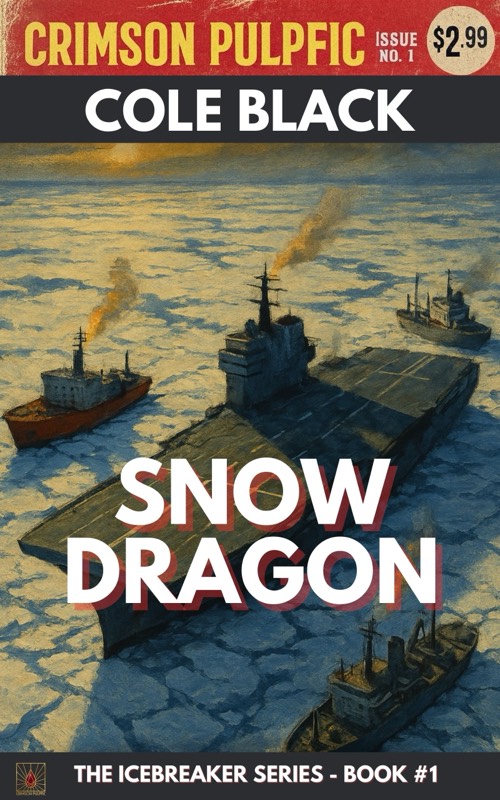
If this subject grabs you the way it grabbed me, I explored a fictional version of this scenario in the Ice Breaker series, written under my pen name Cole Black. It's set in 2045 — a Chinese naval task force enters the Northwest Passage exercising legal transit rights, a reactor fails, ice closes in, and a crisis that nobody wanted turns into a standoff that nobody can stop. The science and geopolitics are drawn directly from the research above. The characters and plot are fiction. The environment is not.
Snow Dragon (Ice Breaker Book 1) is available on Amazon — or browse the full series. Start there.
Jay Tarzwell is a retired Canadian Armed Forces Major, author, and the founder of Crimson PulpFic. He holds a Master of Defence Studies from the Royal Military College of Canada, where his thesis examined the Arctic operating environment in 2045. He spent six years living and working north of the 60th parallel.