






Somewhere north of the 70th parallel, in a stretch of water that is frozen solid for eight months of the year, there is a shipping lane that could reshape global trade, redraw military alliances, and potentially trigger an armed conflict between nuclear powers. It is called the Northwest Passage, and almost nobody can agree on who it belongs to.
Canada says the Northwest Passage runs through Canadian internal waters—that the archipelago of 36,000 islands forming the northern coast of North America creates a boundary as legally definitive as any coastline. The United States says the passage is an international strait, open to transit by any vessel from any nation without prior permission. China, which has declared itself a "near-Arctic state" despite being located roughly 900 miles from the Arctic Circle, agrees with the Americans—and has been building icebreakers to prove the point.
For most of the twentieth century, this disagreement was academic. The Northwest Passage was frozen. Nobody could transit it reliably, so nobody needed to argue about who controlled it. But the ice is melting. And what was once a legal curiosity is becoming, very rapidly, a strategic crisis.
THE LEGAL BATTLEFIELD: UNCLOS AND HISTORIC TITLE
International maritime law is governed primarily by the United Nations Convention on the Law of the Sea (UNCLOS), a treaty signed in 1982 that established the legal framework for oceans, territorial waters, exclusive economic zones, and international straits. The relevant question for the Northwest Passage is deceptively simple: is the passage an internal waterway or an international strait?
Canada's argument rests on two pillars. The first is straight baselines. In 1985, following the unauthorized transit of the US Coast Guard icebreaker Polar Sea, Canada drew straight baselines around its Arctic archipelago, enclosing the waters between the islands as internal waters. Under UNCLOS, a nation has full sovereignty over its internal waters—the same legal status as dry land. No right of passage exists. No foreign vessel may enter without permission.
The second pillar is historic title. Canada argues that Inuit peoples have used the waters of the Arctic archipelago for thousands of years—for hunting, travel, and habitation. These waters are not just geographically Canadian; they are historically, culturally, and functionally part of Canadian territory. The ice itself was, for most of human history, a surface that people lived on, traveled across, and treated as land.
The United States rejects both arguments. Washington's position is that the Northwest Passage meets the legal definition of an international strait: a natural waterway connecting two areas of the high seas (the Atlantic and Pacific Oceans) that is used for international navigation. Under UNCLOS Article 37, ships of all nations have the right of "transit passage" through international straits—a right that cannot be suspended by the coastal state.
The American argument is straightforward: the passage connects two oceans, it has been transited by international vessels, and it therefore qualifies as a strait. Canada's baselines are, in the US view, a unilateral assertion of sovereignty over waters that the international community has a right to use.
The Precedent Problem
The United States has a specific reason for opposing Canada's claim, and it has nothing to do with Canada. If Washington accepts that the Northwest Passage is internal waters, it sets a precedent that other nations could use to close straits that the US Navy considers essential for global force projection. The Strait of Hormuz. The Strait of Malacca. The South China Sea passages. American naval doctrine depends on the principle of freedom of navigation—the right to sail warships through any international strait without permission. Conceding Canada's Arctic claim would undermine that doctrine everywhere.
This is why the United States has never formally recognized Canadian sovereignty over the Northwest Passage, even though Canada is its closest ally. The principle matters more than the relationship. And this is also why the dispute has never been referred to the International Court of Justice: neither side wants a ruling, because both sides are afraid of the precedent a ruling would set.
REAL INCIDENTS: THE PROVOCATIONS THAT SHAPED THE DISPUTE
The SS Manhattan (1969)
The modern sovereignty dispute began with an oil tanker. In 1969, the American-flagged SS Manhattan, an ice-strengthened supertanker, transited the Northwest Passage to test the feasibility of shipping oil from Alaska's North Slope via the Arctic rather than by pipeline. The voyage was technically successful—the Manhattan made it through, with the assistance of a Canadian icebreaker—but it created a political firestorm.
Canada had not been formally asked for permission. The United States considered the passage international waters and saw no need to ask. The Canadian public was outraged. Prime Minister Pierre Trudeau responded by introducing the Arctic Waters Pollution Prevention Act (AWPPA) in 1970, which asserted Canadian jurisdiction over pollution control in Arctic waters up to 100 nautical miles from the coast. It was not a sovereignty claim per se, but it was the first legislative assertion of Canadian authority over the passage.
The Polar Sea (1985)
The provocation that crystallized the dispute came sixteen years later. In August 1985, the US Coast Guard icebreaker Polar Sea transited the Northwest Passage en route from Greenland to Alaska. The United States informed Canada of the transit but did not request permission—a deliberate distinction. Washington was asserting the right of transit passage through an international strait.
The Canadian reaction was immediate. Secretary of State for External Affairs Joe Clark declared that Canada would draw straight baselines around the Arctic archipelago, formally enclosing the Northwest Passage as internal waters. He also announced plans to build a Polar 8 icebreaker—the most powerful non-nuclear icebreaker ever designed—to enforce Canadian sovereignty in the Arctic. The Polar 8 was eventually cancelled due to cost overruns. The sovereignty claim remained.
USS Seadragon and the Submarine Question
Perhaps the most unsettling dimension of the dispute involves what happens under the ice. In 1960, the nuclear submarine USS Seadragon transited the Northwest Passage submerged, passing beneath the ice without surfacing in Canadian waters. The transit demonstrated that submarines could use the passage without detection—and without any coastal state knowing they were there.
This capability has never gone away. Nuclear submarines from the United States, Russia, the United Kingdom, and France regularly operate in Arctic waters. The ice provides acoustic cover that makes detection extremely difficult. Canada's ability to monitor submarine activity in its own claimed waters is, to put it diplomatically, limited. The Royal Canadian Navy does not operate nuclear submarines and has minimal under-ice detection capability in the Arctic archipelago.
CHINA'S ARCTIC AMBITIONS: THE POLAR SILK ROAD
The most significant development in Arctic geopolitics over the past decade has been China's emergence as an Arctic actor. In 2018, China's State Council published a white paper declaring China a "near-Arctic state" and outlining Beijing's vision for a Polar Silk Road—a network of Arctic shipping routes that would connect Chinese ports to European markets via the Northern Sea Route (along Russia's coast) and, potentially, the Northwest Passage.
China has backed its ambitions with hardware. The People's Liberation Army Navy operates two icebreakers: the Xue Long (Snow Dragon) and the newer Xue Long 2, China's first domestically built polar research vessel. A nuclear-powered icebreaker is reportedly under development. China has also invested heavily in Arctic research infrastructure, including a research station in Svalbard, Norway, and extensive oceanographic survey programs in both the Arctic and Antarctic.
Beijing's interest in the Arctic is driven by economics. A shipping route through the Northwest Passage would cut the distance between Shanghai and Rotterdam by approximately 7,000 kilometers compared to the current route through the Suez Canal. For a nation that exports more goods by sea than any other country on Earth, the savings in fuel, time, and transit fees would be enormous.
But China's Arctic presence also has military implications. The People's Liberation Army Navy has expanded its blue-water capabilities dramatically over the past two decades. Chinese naval vessels have conducted exercises in the Bering Sea and Aleutian Islands. Intelligence-gathering ships have been observed in Arctic waters. The line between "scientific research" and "military reconnaissance" in the Arctic is, at best, blurry.
"When a nuclear-powered warship 'breaks down' in your sovereign waters and you lack the capability to tow it out, sovereignty becomes theoretical rather fast."
RUSSIA'S NORTHERN FLANK: MILITARIZING THE ICE
While China builds icebreakers, Russia builds bases. Since 2014, Russia has reopened and expanded Soviet-era military installations across its Arctic coastline. The Northern Fleet, based in Murmansk, operates the world's largest nuclear-powered icebreaker fleet. Russia has deployed S-400 air defense systems, Bastion coastal defense missiles, and MiG-31 interceptors to Arctic bases. New military facilities have been constructed on Franz Josef Land, Novaya Zemlya, and the New Siberian Islands.
Russia's Arctic strategy is built on the Northern Sea Route (NSR)—the shipping lane that runs along Russia's northern coast from Murmansk to the Bering Strait. Moscow has declared the NSR a national transportation corridor and requires all transiting vessels to use Russian icebreaker escorts and Russian pilots. The legal basis for this claim is disputed, but Russia's enforcement capability is not. The Northern Fleet is the most powerful naval force in the Arctic by a significant margin.
Russia's militarization of the Arctic has direct implications for the Northwest Passage. As the Northern Sea Route becomes more commercially viable, shipping traffic in the Arctic increases. More traffic means more military interest. More military interest means more submarines, more surveillance aircraft, and more "freedom of navigation" operations by major naval powers—including in waters that Canada claims as its own.
CANADA'S ARCTIC GAP: THE SOVEREIGNTY WE CANNOT ENFORCE
Canada's Arctic sovereignty claim is legally coherent and historically grounded. It is also, in practical terms, nearly unenforceable.
The Royal Canadian Navy's Arctic capability consists of the Harry DeWolf-class Arctic and Offshore Patrol Ships (AOPS)—a class of ice-strengthened patrol vessels designed for sovereignty operations in the Arctic. As of 2026, three ships have been delivered, with a planned total of six. They are competent vessels for patrol and presence operations, but they are not icebreakers. They can operate in first-year ice up to about one meter thick. The Northwest Passage regularly features multi-year ice several meters thick.
Canada's heavy icebreaker fleet is operated by the Canadian Coast Guard, not the Navy. The fleet is aging. The CCGS John G. Diefenbaker, a new polar icebreaker, has been in the procurement process since 2008. Its delivery date has been pushed back repeatedly and is currently projected for the early 2030s. In the meantime, Canada's most capable Arctic vessel is the CCGS Louis S. St-Laurent, commissioned in 1969.
The Canadian Armed Forces maintain a seasonal presence in the Arctic through Operation NANOOK and the Canadian Rangers—a reserve force of roughly 5,000 members, predominantly Indigenous, who patrol Arctic communities. The Rangers are invaluable for on-the-ground awareness, but they are a light infantry force equipped with rifles and snowmobiles. They are not equipped to interdict a nuclear-powered warship.
The gap between Canada's sovereignty claim and its enforcement capability is the central tension of Arctic geopolitics. Canada asserts that the Northwest Passage is internal waters. But if a Chinese icebreaker, or an American submarine, or a Russian research vessel enters those waters without permission, Canada's options for response are limited to diplomatic protest. Diplomatic protests do not stop ships.
THE FICTION THAT TAKES THIS SERIOUSLY
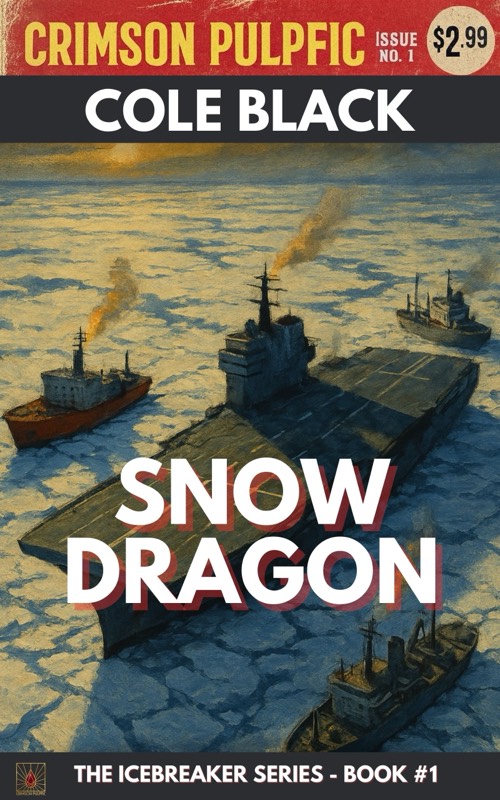
Cole Black's Ice Breaker series begins exactly where the real-world sovereignty dispute leaves off: with a scenario that is entirely plausible and for which Canada has no good answer.
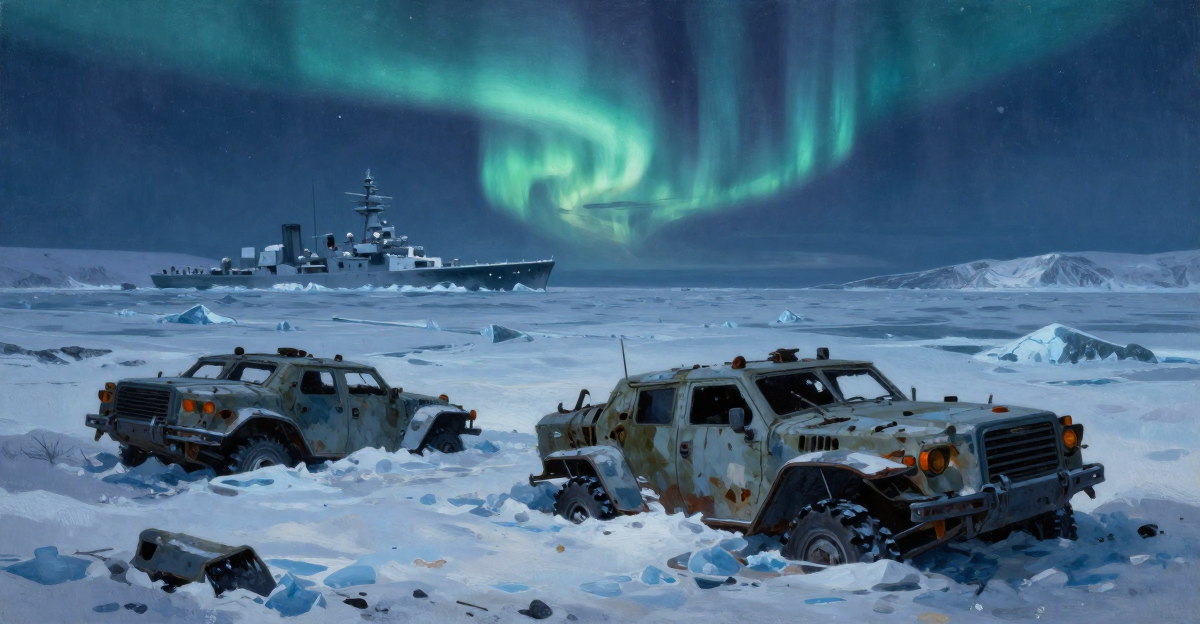
A Chinese naval task force, led by a nuclear-powered vessel, enters the Northwest Passage. It suffers a mechanical failure—or claims to—and becomes unable to leave. Canadian sovereignty is being challenged not by aggression but by presence. A foreign military force is sitting in waters Canada claims as its own, and Canada cannot move it. The diplomatic channels are open. The legal arguments are deployed. And the ship is still there.
The first book, Snow Dragon, builds its narrative on the real architecture of the dispute: the UNCLOS arguments, the limited Canadian Arctic capability, the Chinese naval expansion, the American surveillance apparatus watching everything from above. The intelligence analysis is based on open-source data. The military hardware is accurately described. The political dynamics are drawn from actual policy positions.
This is FICINT—intelligence fiction—and it works because the underlying scenario isn't hypothetical. Every element of the Ice Breaker premise exists in the real world. The question isn't whether a sovereignty crisis in the Northwest Passage could happen. The question is what happens when it does, and whether anyone in Ottawa has a plan beyond sending a diplomatic note.
The ice is melting. The shipping lanes are opening. The icebreakers are being built—just not by Canada. The Northwest Passage sovereignty dispute has been a slow-burn geopolitical crisis for sixty years. Fiction like the Ice Breaker series exists because the real world has been writing this story for decades, and nobody in power seems to be reading it.