

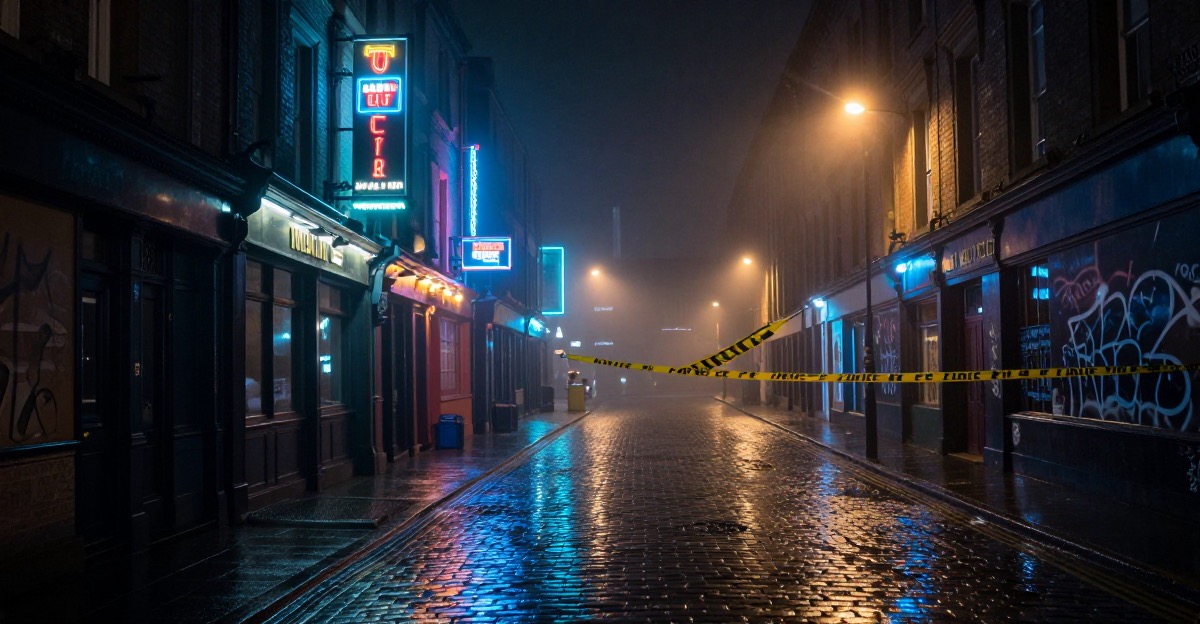
Belfast is a city that knows how to keep secrets. For thirty years, during the period euphemistically called "the Troubles," its residents lived inside an armed conflict that demanded silence as a survival skill. You didn't talk about what you saw. You didn't ask questions about the men who walked your street at night. You learned to read the geography of violence—which roads to avoid, which pubs belonged to whom, which murals on which walls told you that you'd crossed into territory where you weren't welcome.
That kind of city doesn't stop being that kind of city when the guns go quiet. Belfast after the Good Friday Agreement is still Belfast. The peace walls still stand. The murals still mark territory. The silence is inherited. And into that silence walks a vampire detective, which is either the most absurd or the most perfect thing you've ever heard.
It's both. That's why it works.
BELFAST AS NOIR CITY
Noir fiction requires a specific kind of setting. Not just a dark city—any city can be dark. Noir needs a city where the darkness is structural. Where corruption isn't an aberration but a feature. Where the institutions that should protect people are themselves complicit in the harm. Where the protagonist navigates a system designed to grind down anyone who asks too many questions.
Belfast is that city in ways that Los Angeles, Chicago, and New York—the traditional noir settings—can only approximate.
During the Troubles, the Royal Ulster Constabulary (RUC) was not a neutral police force. It was an instrument of state policy in a sectarian conflict, viewed by much of the nationalist community as an occupying force and by the loyalist community as an embattled defender. Officers were targeted for assassination. Some officers colluded with paramilitary groups on both sides. The line between law enforcement and paramilitarism blurred until it was meaningless in certain districts.
The successor force, the Police Service of Northern Ireland (PSNI), was built from the wreckage of the RUC with explicit power-sharing requirements and community oversight. But institutional memory doesn't reset with a name change. The PSNI inherited officers who had served in the RUC. It inherited informant networks. It inherited unsolved cases from a conflict that produced over 3,500 deaths and thousands of injuries. And it inherited a population that had learned, through decades of hard experience, to distrust the police.
This is noir's natural habitat. A detective working in Belfast doesn't just solve crimes. She navigates a landscape where the concept of justice itself is contested. Where the rule of law is simultaneously the official framework and a bitter joke. Where every case potentially connects to the unresolved violence of the past, and where asking the wrong question of the wrong person can be fatal.
Adrian McKinty and the Belfast Procedural
The writer who first demonstrated that Belfast could sustain a noir procedural series was Adrian McKinty, whose Sean Duffy novels are set in 1980s Belfast during the height of the Troubles. Duffy is a Catholic detective in the predominantly Protestant RUC—a man who exists in the wrong place by definition. He checks under his car for bombs every morning. He solves murders while the entire society around him is committing murder.
McKinty proved that Belfast noir wasn't just possible but inevitable. The city's history provided everything the genre needed: institutional corruption, moral ambiguity, a population conditioned to silence, and a protagonist who is both inside and outside the system. The Duffy novels were acclaimed precisely because they showed that noir wasn't just an aesthetic—it was the lived reality of policing in a conflict zone.
Stuart Neville's The Ghosts of Belfast (published as The Twelve in the UK) pushed Belfast noir into supernatural territory, with a former paramilitary haunted by the ghosts of people he killed. Neville demonstrated that the city's violence had a gothic dimension—that the dead didn't stay buried in Belfast, metaphorically or otherwise.
The Rose Gallagher series takes the next logical step. If Belfast is already haunted by its history, what happens when you make the haunting literal?
BRAM STOKER WAS IRISH
This is the fact that everyone forgets, and it changes everything about how we read vampire fiction.
Bram Stoker was born in Clontarf, Dublin, in 1847. He grew up in a country that was, during his childhood, experiencing the aftermath of the Great Famine—an event that killed roughly a million people and drove another million into emigration. Ireland in the mid-nineteenth century was a colonized nation where the ruling power had presided over a catastrophic failure that looked, to many Irish people, like deliberate genocide.
Stoker wrote Dracula in 1897, and the novel is saturated with colonial anxiety. The Count is an aristocratic predator from the East who feeds on English bodies, drains their vitality, and colonizes their women. He is the imperial fear inverted—the colonized other arriving on English shores to do to England what England had done to the world. Literary scholars have debated the colonial subtext of Dracula for decades, but the Irish reading is unavoidable: Stoker wrote a monster that embodied the dynamics of extraction, exploitation, and dehumanization that he had witnessed in his own country.
The vampire, in the Irish literary tradition, is not a foreign import. It's a native species. Irish folklore is dense with revenants, the undead, and creatures that feed on the living. The dearg-due (red blood sucker) appears in Irish mythology centuries before Stoker. The abhartach—a tyrannical chieftain who rose from the dead to terrorize his people until he was buried upside-down with a sword across his chest—is sometimes cited as Stoker's primary inspiration.
When a vampire detective walks the streets of Belfast, she's not borrowing from a foreign tradition. She's coming home.
ROSE GALLAGHER: COP FIRST, VAMPIRE SECOND
The Rose Gallagher series makes a distinction that separates it from most urban fantasy: Rose is a detective sergeant who happens to be a vampire, not a vampire who happens to solve crimes. The emphasis matters.
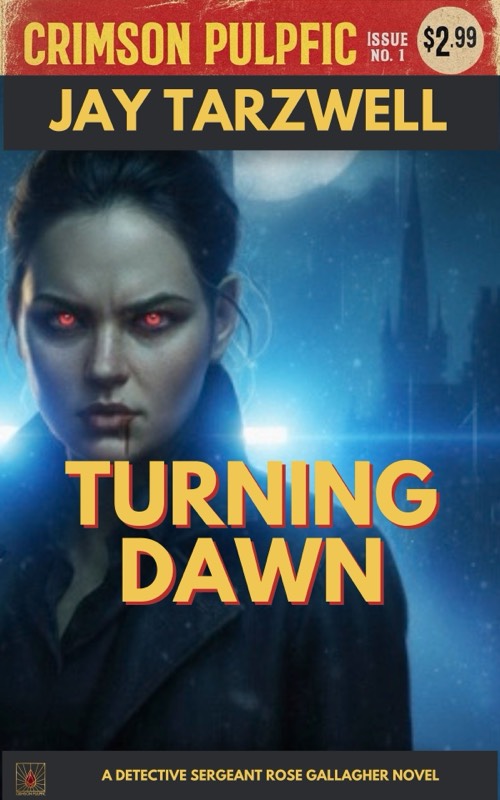
In the first book, Turning Dawn, Rose is a working PSNI officer investigating her daughter's kidnapping when she is attacked and transformed. The transformation is not a gift. It's a catastrophe. Rose doesn't gain superpowers and embrace her new identity. She hides it, fights it, and regards it with the same grim practicality that she brings to every other problem in her life.
This approach grounds the supernatural elements in the procedural reality of Belfast policing. Rose still has to file reports. She still has to manage informants. She still has to navigate the political minefield of a post-Troubles police service where every investigation potentially touches on legacy violence. The vampirism adds capabilities—enhanced senses, physical strength, an awareness of the dead that sometimes helps and sometimes horrifies—but it doesn't change the fundamental nature of her work.
Rose solves crimes the way a real detective solves crimes: through witness statements, forensic evidence, institutional knowledge, and the slow accumulation of facts that eventually point toward the truth. The supernatural elements complicate the process rather than shortcutting it. Rose can sense things that human officers can't, but she can't use those perceptions as evidence. She knows things she can't explain to her colleagues. She sees connections that would sound insane if she voiced them.
"The dead tell Rose things. The living tell her other things. Her job is to find where the two stories meet and decide which version is the lie."
The Vampire as Metaphor
In Belfast, the vampire metaphor resonates on multiple levels that it wouldn't in another city.
Immortality as witness. A vampire lives long enough to remember what everyone else wants to forget. In a post-conflict society built on strategic amnesia—where the peace process requires a certain amount of deliberate forgetting—an immortal witness is a walking threat to the agreed-upon narrative. Rose remembers what the peace walls were for. She remembers the faces of people who disappeared. She remembers things that powerful people would prefer to remain forgotten.
Feeding as extraction. The vampire feeds on human blood. In a city with a history of exploitation—colonial extraction, paramilitary taxation, institutional abuse—the image of someone who survives by taking from others has a specific resonance. Rose's struggle to control her hunger mirrors the struggle of anyone who has power over vulnerable people and tries to use that power responsibly.
Passing as survival. A vampire must hide what she is to survive among humans. In Belfast, passing—concealing your identity, your allegiances, your community background—was a survival skill during the Troubles and remains a social reflex in the post-conflict era. Rose passes as human the way Belfast residents pass as neutral: not because they want to, but because the alternative is dangerous.
Transformation as trauma. Rose didn't choose to become a vampire. It was done to her through violence. The transformation left her fundamentally changed—stronger in some ways, damaged in others, permanently different from the person she was before. This is the structure of trauma itself, and it maps onto the experience of an entire city that was transformed by thirty years of violence and came out the other side changed in ways that are still being understood.
THE LITERARY TRADITION: FROM STOKER TO BELFAST NOIR
Rose Gallagher sits at the intersection of several literary traditions, and the series draws strength from all of them.
Irish Gothic. The tradition that runs from Charles Maturin's Melmoth the Wanderer (1820) through Sheridan Le Fanu's Carmilla (1872) to Stoker's Dracula. Irish Gothic is distinguished by its preoccupation with history, inheritance, and the way the past refuses to release its grip on the present. Rose is an inheritor of this tradition—literally, in that she inherits a vampire's immortality, and thematically, in that her stories are always about the past intruding on the present.
Belfast noir. The tradition established by McKinty and Neville, in which Belfast's sectarian geography and post-conflict psychology provide the architecture for crime fiction. Rose operates within this tradition's rules: the city is a character, the institutions are compromised, and the detective is always, to some degree, complicit in the system she serves.
Police procedural. The tradition of Rebus, Morse, and Wallander—detectives who are defined as much by their institutional context as by their investigative skills. Rose's relationship with the PSNI is central to the series. She's not a lone wolf. She's an officer within a bureaucracy, subject to its politics, its hierarchies, and its contradictions.
Urban fantasy. The tradition of Jim Butcher's Harry Dresden, Ben Aaronovitch's Rivers of London, and Mike Carey's Felix Castor. The Rose Gallagher series shares these works' fundamental premise—supernatural beings operating within a recognizably real urban environment—but differs in tone. Where most urban fantasy is wisecracking and action-driven, Rose Gallagher is quiet, procedural, and psychologically focused. The supernatural isn't fun. It's a burden.
WHAT MAKES THE ROSE GALLAGHER SERIES DIFFERENT
Urban fantasy is a crowded market. Vampire detectives are not, in themselves, a novel concept. So why does this particular version work?
Three reasons.
First, Belfast. The setting isn't decoration. It's the engine. Every case Rose investigates connects to the city's history of conflict, and the supernatural elements amplify rather than escape from that history. You can't write Rose Gallagher in New York or London. The stories are Belfast stories. They depend on the specific dynamics of a post-conflict society where the peace is real but incomplete, where the institutions are reformed but not fully trusted, and where the past is officially behind everyone but actually underneath everything.
Second, the vampirism is a cost, not a gift. Most urban fantasy treats supernatural abilities as power-ups. Rose's vampirism isolates her from her colleagues, threatens her relationship with her daughter, creates ethical dilemmas about the use of abilities that no one can verify, and imposes a hunger that is both physical and metaphorical. The series treats the supernatural with the same unflinching realism that it brings to the procedural elements. There are no easy answers and no clean solutions.
Third, Rose is an ordinary detective doing extraordinary work. She's not a chosen one. She's not prophesied. She didn't volunteer for this. She's a working mother with a police rank, a caseload, and a condition she didn't ask for. Her heroism isn't in the supernatural abilities but in the decision to keep doing the job despite everything. She gets up in the morning—or the evening, as the case may be—and she goes to work. In a genre that loves spectacle, that quiet determination is radical.
The Rose Gallagher series starts with Turning Dawn and continues through five more books, each deepening Rose's relationship with Belfast, her condition, and the cases that force her to confront both.
Belfast is a city that has survived everything history threw at it. Its detective has survived something worse. Together, they make the case that noir and the supernatural aren't genres that collide—they're genres that were always the same story, told in different registers.
Pick up Turning Dawn. Let Belfast show you what it knows about the dark.