






At minus forty degrees Celsius, exposed human flesh freezes in under five minutes. That is not a figure of speech. That is not an approximation for dramatic effect. That is the clinical reality of what happens to skin, muscle, and blood vessels when they are exposed to temperatures that low without protection. The moisture in your tissue crystallizes. The cells rupture. The damage is often permanent.
At minus twenty, you have more time. Thirty to sixty minutes before hypothermia sets in, assuming you are wearing clothes that were not designed for a Caribbean deployment. At minus forty, that window collapses to ten to twenty minutes. Your core body temperature drops. Your cognitive function degrades. You stop shivering—which is not a sign that you are warming up. It is a sign that your body has given up trying.
Now put a thousand soldiers in that environment wearing tropical uniforms, and see what happens.
THE SCENARIO
A People's Liberation Army Navy Type 075 landing helicopter dock—one of China's largest amphibious assault ships—is returning from a six-to-twelve-month deployment in the Caribbean. The ship carries roughly 1,000 PLAN Marines. They have been conducting joint exercises with Mexican Marines in tropical and subtropical conditions. They are equipped accordingly: Type 95 bullpup assault rifles, standard body armor, warm-weather uniforms, and individual equipment suited for temperatures that never drop below fifteen degrees.
Through circumstances I will get to shortly, that ship and those marines end up in the Canadian Arctic. In winter. Where it is routinely minus forty.
They have no Arctic parkas. No winter clothing layers. No extreme cold weather boots rated to minus forty. No Arctic sleeping systems. No cold-weather lubricants for their weapons. No experience operating in extreme cold. And critically, no rations designed for the 6,000-plus calories per day that the human body demands when it is burning energy just to stay alive in a polar environment. Their standard rations provide roughly 3,000.
Half the calories. None of the gear. No training for the environment they are in.
This is not a combat problem. This is a survival problem. And the physics do not care about your training, your discipline, or your national pride.
WHY YOU CANNOT TOUGH IT OUT
There is a persistent belief among people who have never operated in extreme cold that willpower and physical conditioning can compensate for equipment deficiencies. They cannot. Cold does not negotiate. It is a physics problem, and the physics are straightforward.
The human body generates heat through metabolism. In temperate conditions, the clothing you wear traps that heat against your skin, creating an insulating layer. The system works because the differential between your body temperature and the ambient air is manageable. A good jacket, some base layers, and you are fine.
The 77-Degree Gap
At minus forty, the differential is catastrophic. Your body is 37 degrees Celsius. The air is minus 40. That is a 77-degree gap. Heat flows from hot to cold, and it flows fast. Without purpose-built insulation—multiple layers including moisture-wicking base layers, synthetic or fleece mid-layers, a Gore-Tex outer shell, and an Arctic parka with a fur ruff—your body cannot generate heat fast enough to replace what it is losing. You cool. You cool rapidly. And then you die.
This is not a matter of being tough. Canadian soldiers operating in the Arctic wear a layered extreme cold weather system rated to minus fifty. Mukluks or vapor barrier boots. A sleeping system that will keep you alive at minus fifty when you stop moving. They consume rations specifically designed to provide the caloric surplus that Arctic conditions demand.
When Your Equipment Quits First
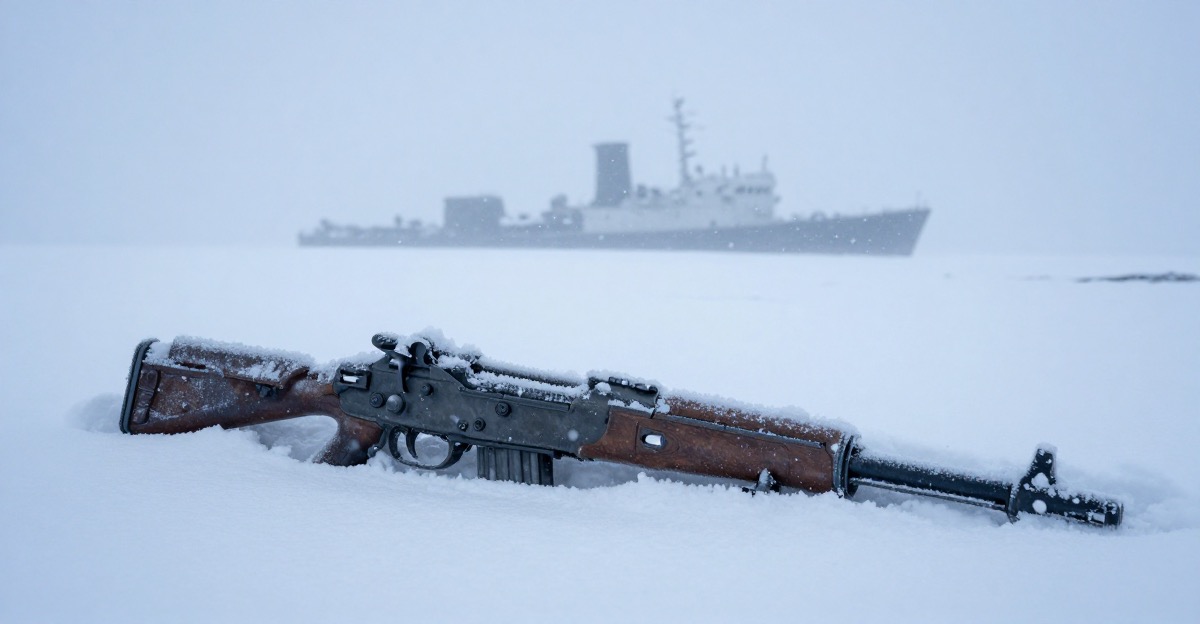
A soldier who is not consuming enough calories loses body heat faster. A soldier wearing tropical boots gets frostbite. A soldier without proper mitts cannot operate his weapon—assuming the weapon still functions, which it will not, because the standard lubricants in a Type 95 rifle freeze solid at minus thirty. The firing pin becomes sluggish. The magazines freeze. The batteries powering any optics die within hours. At minus forty, battery capacity drops to roughly twenty percent. Below that, batteries may not function at all.
Your rifle does not work. Your electronics do not work. Your boots are not rated for the temperature. Your body is burning through calories it does not have. And it has been ten minutes.
HISTORY AGREES
This is not theoretical. Armies have been destroyed by cold before, and the pattern is always the same: a force equipped for one environment enters another, and logistics kills more soldiers than the enemy ever could.
Napoleon marched roughly 600,000 soldiers into Russia in June 1812. They were equipped for a summer campaign. The Russian winter began in November. By the time the Grande Armée retreated across the Berezina River in late November, the force had been reduced to fewer than 100,000 effective soldiers. Disease, starvation, and exposure did most of the killing. The Russians barely had to fight. They just had to wait.
In November 1950, roughly 30,000 United Nations forces—primarily US Marines and Army troops—were encircled by Chinese forces at the Chosin Reservoir in North Korea. Temperatures dropped to minus thirty-eight. Weapons froze. Medical supplies froze. Morphine syrettes had to be thawed in medics' mouths before they could be injected. Vehicle engines that were shut off would not restart. The UN forces fought their way out in what the Marines call "attacking in a different direction," but they suffered over 10,000 casualties in seventeen days, with roughly a third of those attributed to cold weather injuries rather than enemy action.
The Chinese forces at Chosin suffered far worse. Entire divisions of the People's Volunteer Army, equipped for temperatures they had never experienced, ceased to function as fighting units. Soldiers froze to death in their foxholes. Some were found in firing positions, weapons aimed, frozen solid. The Chinese had numerical superiority. They did not have winter boots. The cold did not care about their numbers.
That was minus thirty-eight. The Canadian Arctic in winter is routinely colder.
THE LOGISTICS GAP THAT KILLS
Military professionals understand something that civilians and politicians generally do not: wars are won by logistics. Firepower matters. Training matters. But the ability to feed, clothe, shelter, fuel, and resupply your force is what determines whether you have a fighting force at all.
The Canadian Armed Forces maintain an Arctic warfare school. Soldiers who deploy north learn the layering system, the caloric requirements, the weapon maintenance protocols for extreme cold. They learn that you never bring a cold weapon into a warm shelter—the condensation will freeze when you take it back out, and now your weapon is an ice-encased paperweight. They learn that bare skin sticks to cold metal and that touching your rifle without gloves at minus forty will cost you skin from your hand. They learn to keep magazines inside their clothing, against their body heat, so the springs do not freeze.
These are not instincts. They are trained behaviors that take weeks to develop and constant practice to maintain. A force that has been operating in the Caribbean for a year has none of them.
The Vehicle Problem
The equipment gap is just as severe. Canadian Arctic kit includes a sleeping system rated to minus fifty Celsius. The Chinese marines on that Type 075 have ship berths. Fine when you are on the ship. Useless if you need to operate ashore or if the ship becomes uninhabitable. Canadian forces have ten-person Arctic tents, portable stoves, and the training to build emergency snow shelters. The Chinese marines have none of these things because they did not need them in Cuba.
Even the vehicles fail. Chinese amphibious vehicles—the ZBD-05, the ZTL-11—are designed for warm-water beach landings, not Arctic operations. Diesel fuel gels below minus forty without Arctic-grade additives. Engine block heaters are required, or engines must run continuously. Hydraulic fluid thickens. Rubber seals become brittle and crack. Helicopters face rotor icing, increased fuel consumption, lubricant failures. Chinese helicopter operations in a Canadian Arctic winter would likely fail within weeks due to maintenance issues alone.
THE MASS CASUALTY MATH
If 1,000 inadequately clothed and equipped marines are exposed to Arctic winter conditions for an extended period, the casualty projections are grim and straightforward.
Frostbite affects fifty to seventy percent of personnel, at varying levels of severity. Without proper footwear, toes and feet go first. Without proper gloves, fingers follow. Hypothermia deaths reach five to fifteen percent if shelter is inadequate. Non-battle injuries—falls on ice, equipment accidents, vehicle mishaps in conditions crews have never trained for—account for thirty percent or more. Psychological casualties are significant and compounding: troops acclimatized to tropical conditions who are suddenly plunged into twenty-four-hour polar darkness at minus forty, with no training, no preparation, and no timeline for rescue, break down.
This is not a battle. This is an environment imposing its terms on a force that is not equipped to meet them. The Canadian Arctic does not need to shoot at you. It just needs you to be there, unprepared, for long enough.
WHY THIS MATTERS FOR FICTION
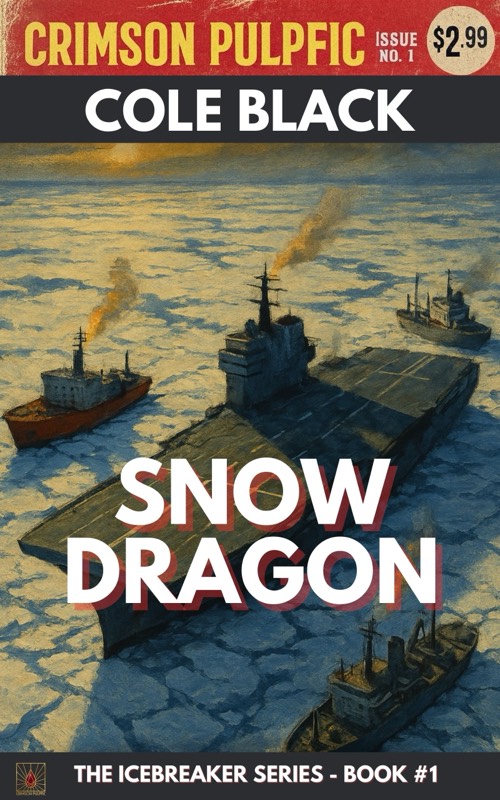
Cole Black's Ice Breaker series is built on this exact asymmetry. A PLAN naval task force, returning from a Caribbean deployment, ends up in the Canadian Arctic through a sequence of events that is entirely plausible and for which there is no good precedent in international law. The Chinese are not incompetent. They are not poorly trained. They are simply in the wrong environment with the wrong equipment, and the environment does not grade on a curve.
The series works as fiction because the technical foundation is real. Every detail—the hypothermia timelines, the caloric requirements, the weapon malfunctions, the vehicle failures, the clothing gap—is drawn from actual military doctrine and Arctic operations research. The Canadian forces opposing them have their own problems: limited numbers, aging equipment, vast distances. But they have the one thing the Chinese do not. They are dressed for it.
"The Arctic does not care about your force projection capabilities. It cares about whether your boots are rated to minus forty."
This is the deeper point that the Ice Breaker series makes, and it is the same point that military history has been making for centuries: the force that wins is not always the one with more soldiers, more firepower, or better technology. It is the one that can feed its troops, keep them warm, and keep their equipment functional. Logistics is not glamorous. It does not make for exciting procurement announcements or stirring political speeches. But it is the difference between a fighting force and a thousand people freezing to death in someone else's territory.
Napoleon learned this. The Chinese at Chosin learned this. And in the Ice Breaker series, a modern PLAN Marine battalion is about to learn it again—in a part of the world that has been teaching this lesson since before humans had the poor judgment to go there in the first place.
The first book, Snow Dragon, is available now. Dress warmly.