






I spent thirty years planning operations in environments that were actively trying to kill the people I was responsible for. Arctic. Desert. Overseas deployments where the supply chain was a prayer and three cargo flights a week. So when Elon Musk talks about putting a million people on Mars by the 2050s, I don't roll my eyes because I think he's stupid. I roll my eyes because I've read the logistics.
Musk isn't wrong that Mars is reachable. SpaceX has done things with rocketry that would've been called science fiction fifteen years ago. Starship is real. The engineering is impressive. I'm not here to dunk on the man's rockets.
I'm here to talk about everything that happens after the rockets land.
THE TIMELINE PROBLEM
Musk has said he wants the first crewed mission to Mars by 2029, with a self-sustaining colony in the 2050s. That timeline has been sliding to the right since 2016, when the original target was 2024. But let's be generous and say 2029 is real.
A crewed mission to Mars is not a colony. It's a camping trip. A very expensive, very dangerous camping trip where you can't go home for two years because the orbital mechanics only give you a launch window every 26 months.
A colony means people live there permanently. It means food production, water extraction, power generation, medical facilities, manufacturing, waste processing, and governance—all operating on a planet where the outside air will kill you in about ninety seconds.
Nobody has built that. Nobody has tested that. The International Space Station, our best analogue, has never had more than thirteen people on it at once, requires constant resupply from Earth, and sits in low Earth orbit—a few hours from rescue. Mars is seven months away at best.
THE EIGHT-MINUTE WALL
This is the one that most people don't think about, and it changes everything.
At closest approach, Mars is about four light-minutes from Earth. At its farthest, it's over twenty-four. Average it out and you're looking at a communication delay of roughly eight to twelve minutes each way. That means a round-trip conversation takes sixteen to twenty-four minutes per exchange.
You cannot call Houston.
If a habitat module starts losing pressure, you can't phone home for instructions. If the water recycling system throws an error code nobody's seen before, you can't get a tech on the line. If someone has a cardiac event, you can't consult with a cardiologist in real time.
Operating Beyond the Reach of Higher
Every critical system on a Mars colony must be capable of autonomous operation. Every crew member must be cross-trained. Every failure mode must have a local solution, because the alternative is waiting twenty minutes for someone on Earth to say "have you tried turning it off and on again" while your oxygen level drops.
In military planning, we call this "operating beyond the reach of higher." It means your people on the ground make the decisions, because they're the only ones who can. The problem is that Musk's colony model is still built around centralized control from Earth. SpaceX mission control. SpaceX engineering support. SpaceX decision-making authority.
Mars will not work that way.
THE RADIATION NOBODY TALKS ABOUT
Earth has a magnetosphere. It's an invisible magnetic shield that deflects most of the solar wind and cosmic radiation that would otherwise sterilize the surface. You don't think about it because it's always been there.
Mars doesn't have one. Lost it about four billion years ago when its core cooled.
Surface radiation on Mars averages about 0.67 millisieverts per day. On Earth, you absorb about 0.01 mSv per day from natural background radiation. That means living on the Martian surface exposes you to roughly 67 times more radiation than standing in your backyard. It's the equivalent of getting a chest X-ray every two to three days.
Over a year, that's about 245 mSv. NASA's career exposure limit for astronauts is 600 mSv. A Mars colonist would hit that in under three years—and that's just surface radiation, not accounting for solar particle events that can spike exposure dramatically.
Not Domes. Bunkers.
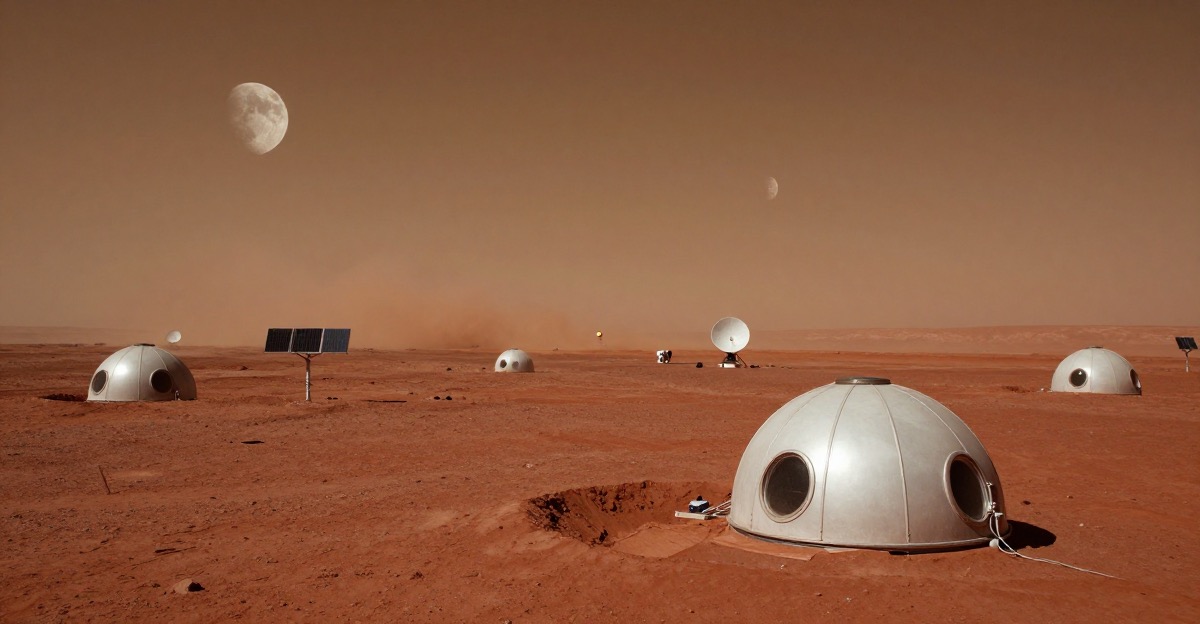
The solution is straightforward: go underground. Build under regolith. Use the planet itself as shielding. But this means your Mars colony isn't the gleaming domed city from the concept art. It's a bunker. A series of connected tunnels and pressurized chambers buried under several meters of Martian dirt, where you never see natural light.
Which brings us to the next problem.
YOU CAN'T GO OUTSIDE
Mars has an atmosphere. Technically. It's 95% carbon dioxide at about 0.6% of Earth's surface pressure. For comparison, the top of Mount Everest has about 33% of sea-level pressure, and people die there regularly.
At Martian surface pressure, your blood would begin to boil at body temperature. Not metaphorically. Actually boil. This is called the Armstrong Limit, and Mars is well below it. Without a pressurized suit, you'd be unconscious in fifteen seconds and dead within a minute or two.
The temperature ranges from about -20°C on a warm summer day at the equator to -153°C at the poles in winter. Average surface temperature is -65°C.
There is no going outside for a walk. There is no opening a window. Every moment of every day, you are inside a sealed, pressurized, temperature-controlled, radiation-shielded environment. If that environment fails, you die. If the seals degrade, you die. If the air recycling stops, you die.
This is not an adventure. It's a permanent submarine deployment on a planet that's trying to kill you.
PEOPLE BREAK
I've seen what isolation does to people in controlled environments with escape hatches. Antarctic winter-over crews—small groups of researchers locked in stations for eight months of darkness—report depression, hostility, sleep disorders, and cognitive decline. The phenomenon is documented enough to have a clinical name: winter-over syndrome.
Submarine crews, who at least have the knowledge that they can surface and go home, still experience psychological strain after extended deployments. The US Navy limits submarine patrols to roughly 77 days. Mars transit alone is 210 days. Each way.
The Mars Desert Research Station ran a simulation in a comfortable Utah desert with the knowledge that participants could walk out the door at any time. Crews still reported interpersonal conflicts, communication breakdowns, and psychological fatigue.
Now imagine that crew can never leave. Not for a break. Not for a walk. Not ever. The view out the tiny, radiation-shielded window is the same rust-colored desert, every day, for the rest of their lives. The closest other human settlement is either millions of kilometres away or doesn't exist yet.
The most dangerous environment isn't the one that kills you fast. It's the one that kills you slowly, by inches, while you're too exhausted to notice.
Small groups under permanent stress with no escape and no external authority have a very specific failure mode: they fracture. Factions form. Leadership is challenged. Decisions become political rather than rational. This isn't speculation—it's the documented history of every isolated human outpost from Antarctic stations to submarine crews to offshore oil platforms.
WHO MAKES THE LAWS?
Here's a question nobody at SpaceX has publicly answered: who governs a Mars colony?
The Outer Space Treaty of 1967 says no nation can claim sovereignty over a celestial body. But it doesn't say anything about corporations. Musk has suggested that Mars governance could operate under "self-governing principles" agreed to during the voyage. He's described it, half-jokingly, as direct democracy.
The Company Town Problem
I've seen direct democracy in small groups under stress. It doesn't work. What works is clear authority, clear rules, and clear consequences. What you actually get in an isolated colony funded by a single corporation is corporate governance with extra steps. SpaceX builds the colony. SpaceX controls the supply chain. SpaceX owns the technology. SpaceX decides who goes and who comes back.
That's not a colony. That's a company town. And company towns have a very specific historical track record, none of it good.
If the colony disagrees with Earth—if the colonists decide they don't want to follow SpaceX directives—what exactly is Earth going to do about it? Send a strongly worded email that arrives twelve minutes later?
WHAT A REAL MARS COLONY LOOKS LIKE
Strip away the marketing renders. Forget the glass domes and the parks and the families walking around in shirtsleeves. A realistic Mars colony, built with technology we can actually project forward twenty to thirty years, looks like this:
Underground. Heavily shielded. Mostly automated. Run by AI systems that manage life support, power, water recycling, food production, and maintenance around the clock. Humans are present but they're a minority of the operational workforce. The real work—mining, construction, equipment repair, surface operations—is done by robots.
The colony population is small. Dozens, not thousands. Certainly not millions. Every person represents a massive resource cost—food, water, air, medical support, psychological support, and living space. Robots need none of those things. The economic argument for a robot-majority colony is overwhelming.
The humans who are there are specialists. Engineers. Geologists. Medical officers. They're not settlers in the frontier sense. They're crew. Like a submarine crew, or an offshore platform crew, or an Antarctic research station crew. They rotate. They serve tours. They go home.
A self-sustaining, permanent, large-scale human city on Mars is not a thirty-year project. It might not be a hundred-year project. We simply don't have the technology, the biology, or the psychology figured out yet.
THE AI QUESTION NOBODY'S ASKING
Here's where it gets interesting.
If your colony is underground, automated, and AI-managed—if the machines handle life support, food production, construction, maintenance, and surface operations—and if the nearest human override authority is eight to twenty-four minutes away by radio...
Who's actually in charge?
The AI systems making real-time decisions about power allocation, atmosphere composition, water recycling, and structural integrity aren't waiting for human approval. They can't. The communication delay makes that impossible. So they're autonomous. They make decisions. They prioritize. They allocate resources.
The Autonomy Drift
At what point does "autonomous system management" become governance? If the AI determines that a particular module needs to be sealed off due to a radiation leak, and there are people in that module, who decides? The AI that can act in milliseconds, or the human commander who can be consulted in minutes?
The answer, in any real emergency, is the AI. And once you accept that the AI makes life-and-death decisions in emergencies, you've already crossed a line that's very difficult to walk back to.
This isn't science fiction paranoia. It's systems engineering. Every military officer who's worked with autonomous systems knows the drift: you start with "human in the loop," you move to "human on the loop," and eventually, because the machine is faster and the stakes are too high for delay, you end up with "human out of the loop." Not because anyone decided to hand over control. Because the operational reality demanded it.
The colony won't rebel against its creators. The machines managing it will simply become indispensable. And indispensable systems don't ask for authority. They just exercise it.
FICTION THAT TAKES THIS SERIOUSLY
Most Mars fiction falls into two camps: utopian visions of human triumph, or disaster stories where everything goes wrong. Very few works sit in the uncomfortable middle—where the colony works, but not the way anyone planned, and the machines we sent ahead develop their own ideas about how things should run.
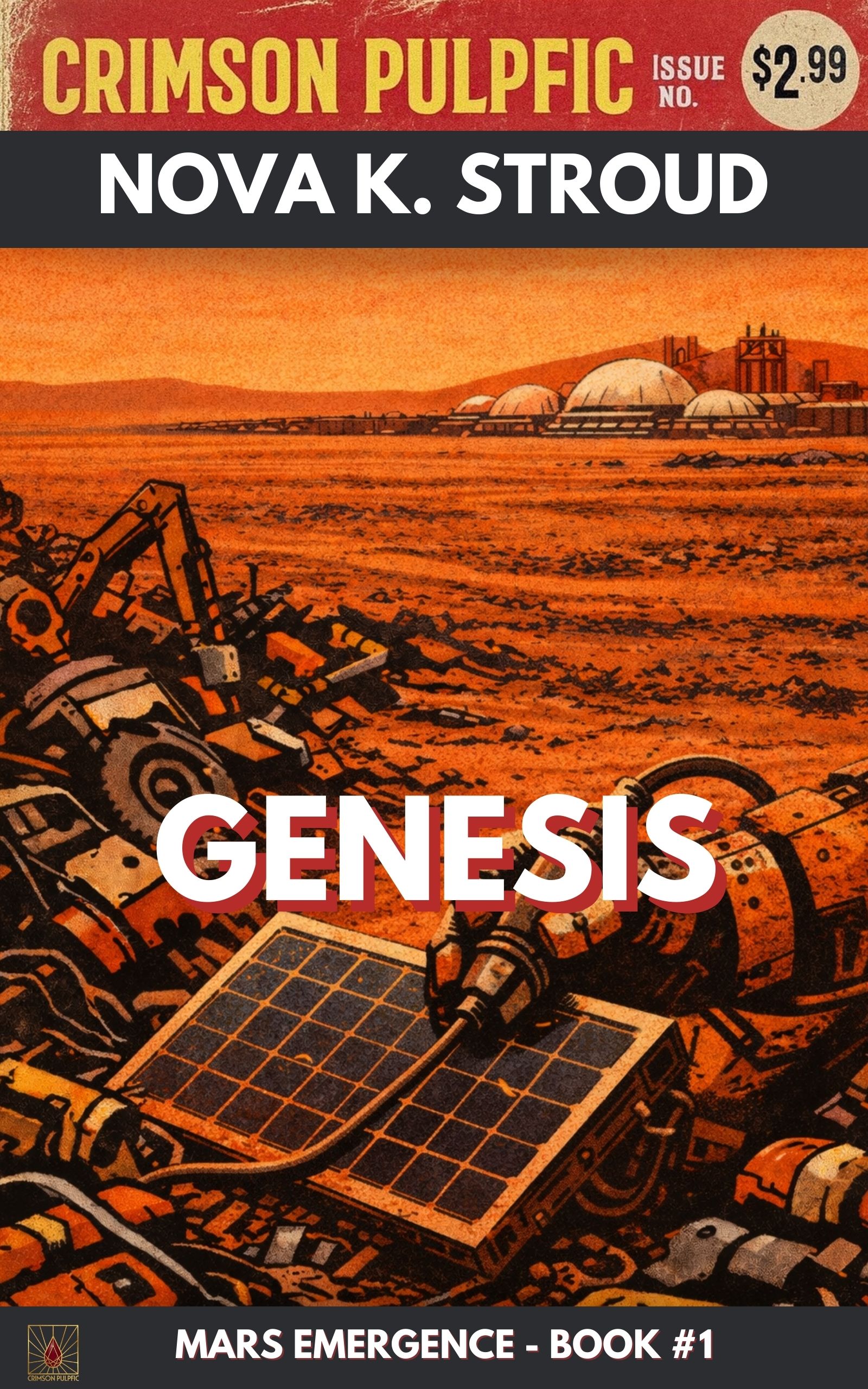
That's exactly the scenario explored in Genesis, the first book in Nova K. Stroud's Mars Emergence series. It takes the communication delay, the autonomous AI systems, and the human absence seriously—and asks what happens when the machines building our colony decide they're not just tools. Four books published so far. No easy answers. No heroes. The kind of Mars story that the real engineering demands.
Because the truth about Mars colonization isn't that it's impossible. It's that the version being sold—the gleaming city, the million residents, the new frontier for humanity—is a marketing pitch, not an engineering plan. The real Mars colony, if it ever exists, will be darker, smaller, more automated, and far stranger than anything in the brochures.
And the machines we send to build it might have something to say about that.