



There's a genre hiding in plain sight. It sits on the shelf between military thrillers and spy novels, but it isn't quite either of those things. It doesn't announce itself with explosions. It doesn't open with a car chase through Monaco or a gunfight in a Beirut safe house. It opens, more often than not, with someone staring at a satellite photograph and realizing that something is deeply, terrifyingly wrong.
That genre is FICINT—intelligence fiction. And if you've never heard the term, that's partly the point. FICINT doesn't market itself with flash. It earns its audience the hard way: by being right.
DEFINING FICINT: WHAT INTELLIGENCE FICTION ACTUALLY IS
FICINT (sometimes written as "int-fic") is fiction rooted in the methodology of intelligence analysis. Where a spy thriller might ask "Can our hero escape the enemy compound?", FICINT asks "What happens when an intelligence assessment is wrong and nobody in the chain of command wants to hear it?"
The genre draws its power from open-source intelligence (OSINT), tradecraft procedure, and the bureaucratic machinery that actually drives real-world espionage. It's less James Bond and more the analyst who briefed James Bond and was ignored, then watched the operation fail exactly the way the briefing predicted.
FICINT distinguishes itself through several core characteristics:
- Plausibility over spectacle. Every scenario in FICINT could happen. The technology exists. The political conditions exist. The institutional failures that drive the plot are documented in unclassified after-action reports.
- Process as tension. The intelligence cycle—collection, processing, analysis, dissemination—isn't background noise. It's the engine of the narrative. Characters argue over assessments. Raw signals intelligence gets misinterpreted. Photo analysts see different things in the same satellite imagery.
- Institutional friction. In FICINT, the enemy is rarely just the adversary on the other side. It's the bureaucracy, the political appointees who override the analysts, the interagency rivalries that leave critical intelligence stranded in someone's inbox.
- No jingoism. FICINT respects the adversary's competence. Enemy operators are professionals doing their jobs, not cartoon villains. The Chinese naval officer has a family. The Russian signals analyst is good at her job. Dehumanizing the opposition is a failure of intelligence, and FICINT treats it as such.
THE ROOTS: FROM PULP-ERA SPIES TO LE CARRÉ
Intelligence fiction didn't appear from nowhere. Its roots are tangled in the pulp magazines of the 1930s and 1940s, where stories about spies, saboteurs, and secret agents competed for newsstand space alongside hardboiled detectives and bug-eyed aliens.
The early pulp spy stories were largely adventure fiction with an espionage veneer. They featured dashing agents with improbable gadgets, exotic locations, and beautiful women who were either allies or threats (and sometimes both). The intelligence work itself was window dressing—an excuse to get the hero into a dangerous situation.
The first real shift came with Eric Ambler in the late 1930s. Ambler's novels—The Mask of Dimitrios (1939), Journey into Fear (1940)—introduced amateur protagonists caught in intelligence operations they didn't understand. His spies weren't suave professionals. They were journalists, engineers, and businessmen who stumbled into worlds of political assassination and arms trafficking. Ambler understood something that the pulp spy stories didn't: the most terrifying thing about espionage is how mundane it looks from the inside.
Then came Graham Greene, whose novels blurred the line between literary fiction and intelligence writing. The Quiet American (1955) and Our Man in Havana (1958) treated the intelligence world as a moral landscape—a place where good intentions caused catastrophic harm and cynicism was sometimes the only honest response. Greene had actually worked for MI6, and it showed. His fiction had the texture of institutional reality.
But the writer who truly created the template for modern FICINT was John le Carré.
Le Carré and the Birth of Modern Intelligence Fiction
Le Carré's The Spy Who Came in from the Cold (1963) detonated every convention the spy genre had built. His protagonist, Alec Leamas, was exhausted, alcoholic, morally compromised, and ultimately disposable. The intelligence operation at the novel's center was built on betrayal—not the enemy's, but the protagonist's own service. The people running the operation didn't care about Leamas. They cared about the operation.
Le Carré understood intelligence work because he'd done it. He'd served in MI5 and MI6, and his fiction reflected the actual texture of that world: the endless meetings, the interdepartmental rivalries, the moral corrosion of maintaining cover stories for decades. His Smiley novels—Tinker Tailor Soldier Spy, The Honourable Schoolboy, Smiley's People—are essentially procedurals about intelligence analysis, with George Smiley as a detective whose crime scene is an entire bureaucracy.
Le Carré didn't just write spy novels. He wrote the first true FICINT—fiction where the intelligence process was the story.
FICINT VS. SPY THRILLERS: THE DIFFERENCE THAT MATTERS
The easiest way to understand FICINT is to compare it with what it isn't.
A spy thriller—the kind written by Tom Clancy, Vince Flynn, or Brad Thor—puts a protagonist in danger and asks the reader to ride along. The intelligence elements are there, but they serve the action. The hero gets the briefing, then does the thing. The focus is on execution: the raid, the extraction, the kill shot.
FICINT reverses that emphasis. The intelligence elements aren't in service to the action. The action is a consequence of the intelligence—or the intelligence failure. The briefing is the story. The moment when an analyst realizes the satellite imagery has been deliberately staged. The argument in a SCIF about whether a signals intercept means what the NSA thinks it means. The decision to act on incomplete information because waiting for certainty means people die.
Military fiction shares some DNA with FICINT but operates on a different axis. Military fiction is about the experience of combat, the bonds between service members, the institutional culture of the armed forces. It can be deeply realistic—writers like Anthony Swofford, Phil Klay, and Kevin Powers have written military fiction that's essentially literary journalism. But military fiction centers the soldier's experience. FICINT centers the intelligence picture.
Where the genres overlap is in the consequences. The best military fiction shows what happens when soldiers are sent into situations based on bad intelligence. The best FICINT shows why the intelligence was bad. Together, they tell the complete story.
THE OSINT REVOLUTION: WHY FICINT MATTERS NOW
FICINT has always been relevant, but the rise of open-source intelligence has made it urgent.
OSINT—intelligence derived from publicly available information—has fundamentally changed how the world understands conflict. During the Russian invasion of Ukraine, open-source analysts on social media were tracking troop movements via commercial satellite imagery, geolocating military equipment from TikTok videos, and identifying Russian units by their license plates. The work that once required a security clearance and a classified database now requires a laptop, a VPN, and analytical discipline.
This transformation has created a new kind of intelligence fiction—one where the protagonist isn't necessarily a government agent. They might be a journalist using flight-tracking data to identify CIA rendition flights. They might be an academic using shipping records to map sanctions-busting networks. They might be a sailor watching a foreign naval task force enter waters where it has no business being.
The accessibility of OSINT means that FICINT can be verified in a way that older intelligence fiction couldn't. When a FICINT author describes a specific satellite imagery pattern, the reader can go look at that pattern themselves. When the fiction describes how a naval reactor cooling system works, the engineering is either right or it isn't. This accountability is baked into the genre. FICINT that gets the details wrong isn't just bad fiction—it's bad intelligence.
COLE BLACK'S APPROACH: THE ICE BREAKER SERIES
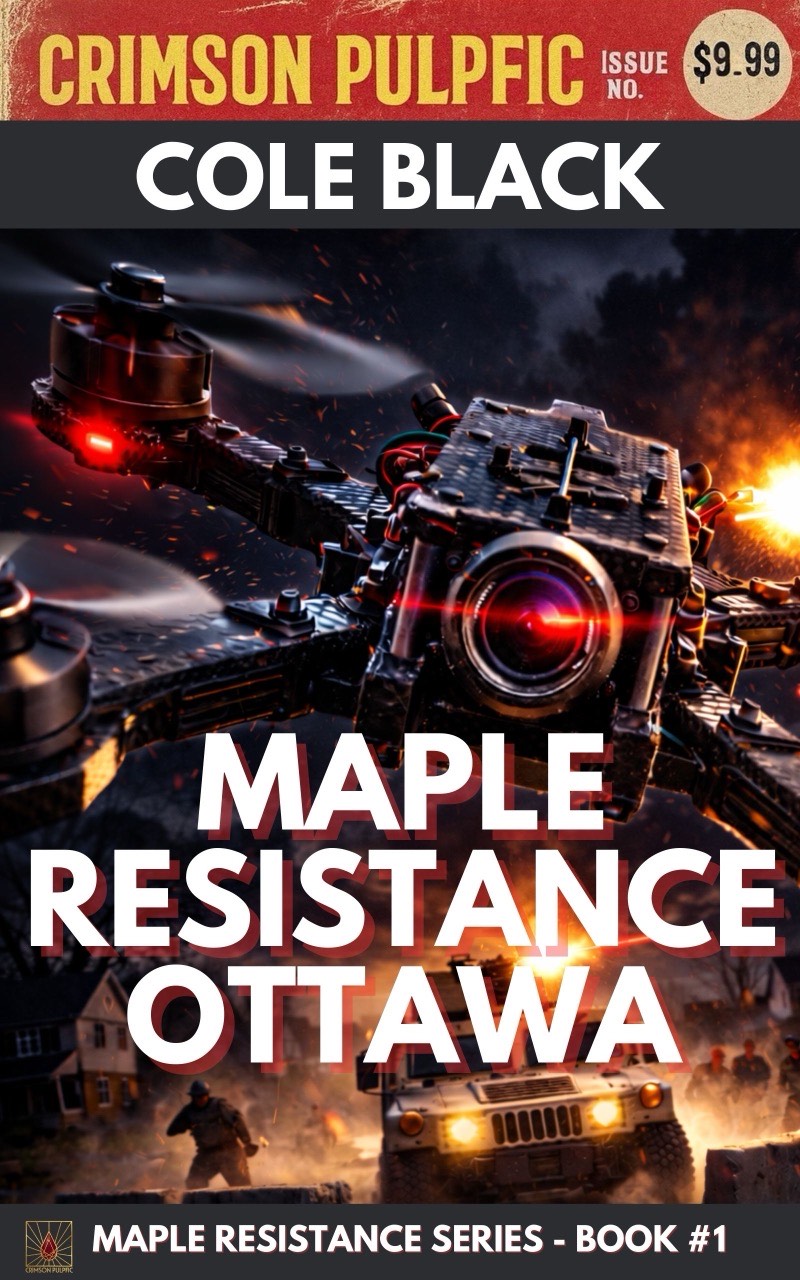
Cole Black writes FICINT for Crimson PulpFic, and his Ice Breaker series is a case study in what the genre can do when it's done right.
The premise is deceptively simple: a Chinese naval task force transiting the Northwest Passage suffers a reactor failure and becomes trapped in Canadian Arctic waters. What follows is a four-book examination of what happens when military, diplomatic, and intelligence systems collide in a crisis that nobody planned for and everybody wants to control.
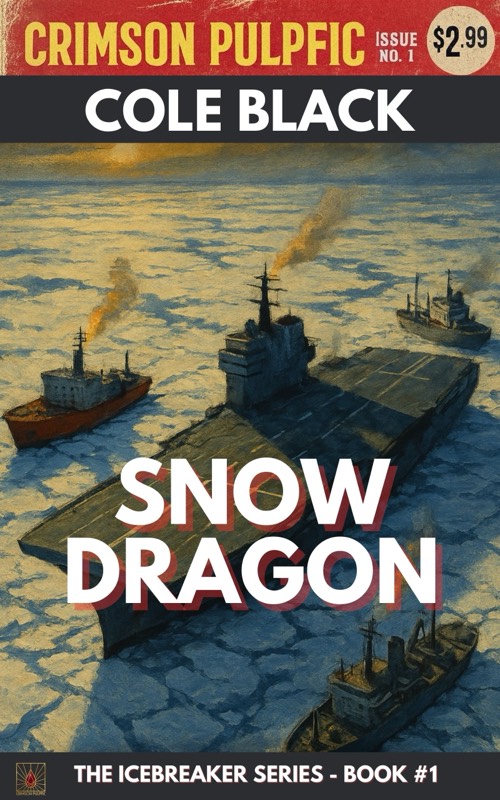
The first book, Snow Dragon, opens not with combat but with analysis. A Canadian intelligence officer watching satellite imagery notices that a Chinese carrier group has deviated from its declared transit route. The deviation is small—a few nautical miles. But in the Arctic, a few nautical miles can mean the difference between deep water and pack ice.
What makes Cole Black's approach distinctly FICINT is the way intelligence drives every decision in the narrative. Characters don't act on instinct or heroic impulse. They act on assessments. Those assessments are sometimes wrong. The consequences cascade.
"The enemy isn't human—it's the cold itself. But the real threat is always the intelligence failure that put people where they shouldn't be."
Cole Black's fiction is rooted in OSINT methodology. The Arctic navigation data is real. The reactor engineering is based on publicly available technical specifications. The diplomatic protocols are drawn from actual international maritime law. The political dynamics—Canada's Arctic sovereignty claims, China's polar ambitions, American surveillance capabilities—are taken from unclassified policy documents and academic research.
This is the FICINT promise: fiction that is plausible because the author did the intelligence work.
THE FICINT LANDSCAPE: WHO ELSE IS WRITING IT
Le Carré cast a long shadow, but contemporary FICINT has evolved well beyond his template.
Mick Herron's Slough House series takes FICINT into darkly comic territory, following disgraced MI5 agents exiled to a bureaucratic purgatory. Herron's genius is in showing that even failed intelligence officers remain dangerous—and that institutional incompetence is as threatening as any foreign adversary.
Charles Cumming writes FICINT that bridges le Carré's Cold War template with modern geopolitics. His Thomas Kell novels deal with MI6 operations in an era of jihadist terrorism, digital surveillance, and intelligence-sharing agreements that can be weaponized.
Jason Matthews' Red Sparrow trilogy brought the perspective of a career CIA officer to fiction. Matthews served for 33 years in the Directorate of Operations, and his novels have the procedural density of an after-action report rewritten as a thriller.
Alex Berenson's John Wells series explores the psychological cost of deep-cover intelligence work. Wells is a CIA operative who converted to Islam during a decade-long infiltration of al-Qaeda, and the series grapples honestly with questions of identity, loyalty, and institutional betrayal.
What unites these writers—and distinguishes them from the broader thriller market—is their commitment to process. In their fiction, intelligence work is work. It's tedious, morally corrosive, institutionally frustrating, and occasionally terrifying. The moments of action are real, but they emerge from the analytical process, not the other way around.
WHY FICINT MATTERS
We live in an era of information warfare, disinformation campaigns, and intelligence failures with global consequences. The invasion of Iraq was predicated on intelligence assessments that were wrong. The fall of Kabul in 2021 was preceded by intelligence assessments that were ignored. The intelligence world shapes our lives whether we pay attention to it or not.
FICINT matters because it teaches readers how to think about information the way intelligence analysts do. Not what to think—how to think. How to evaluate sources. How to distinguish signal from noise. How to recognize when an assessment is being shaped by institutional pressure rather than evidence.
This isn't just useful for understanding geopolitics. It's a survival skill for anyone living in an information environment designed to manipulate them. Social media algorithms, political spin operations, corporate disinformation campaigns—they all use techniques that intelligence analysts are trained to detect. FICINT fiction smuggles that analytical framework into a narrative structure that's compelling enough to keep readers engaged for 300 pages.
The best FICINT doesn't just tell a good story. It makes you a harder target.
WHERE TO START
If you've never read FICINT before, here's where to begin:
- The classics: Le Carré's Tinker Tailor Soldier Spy remains the standard. If you want something shorter, start with The Spy Who Came in from the Cold.
- Modern FICINT: Mick Herron's Slow Horses is the best entry point for readers who want le Carré's institutional realism with a contemporary setting and a streak of dark humor.
- OSINT-based FICINT: Cole Black's Snow Dragon is the first book in the Ice Breaker series and represents the cutting edge of the genre—intelligence fiction built on open-source analysis and real-world military engineering.
- Espionage memoir (nonfiction companion): If you want to understand the real intelligence world that FICINT draws from, start with Robert Baer's See No Evil or Ben Macintyre's The Spy and the Traitor.
The genre isn't loud. It doesn't announce itself. But once you learn to recognize it, you'll find it everywhere—and you'll never read a spy thriller the same way again.