







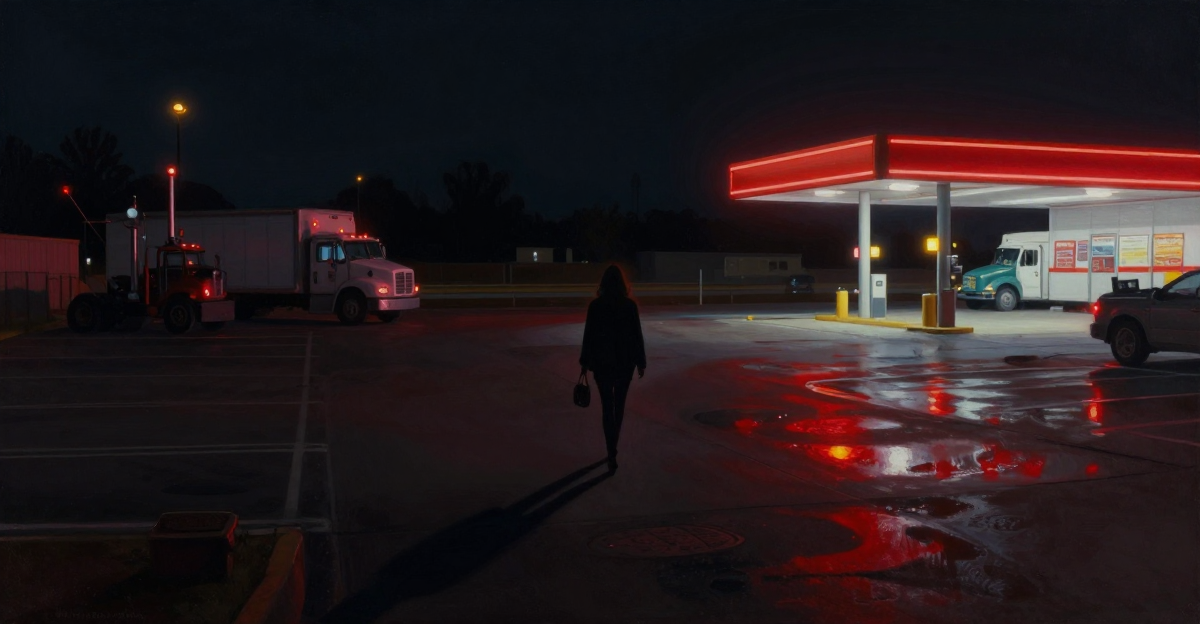
There is a map that most Americans have never seen. It hangs in the FBI's Behavioral Analysis Unit in Quantico, Virginia, and it is covered in dots—hundreds of them, clustered along the interstate highway system like a disease spreading through the country's circulatory system. Each dot represents a body. A woman found in a ditch beside I-40. A woman pulled from a drainage culvert near a truck stop off I-10. A woman whose remains were scattered across a rest area parking lot on I-70.
The map belongs to the Highway Serial Killings Initiative, a program the FBI launched in 2009 after analysts noticed a pattern that local police departments had missed for decades. The pattern was simple and devastating: women were being murdered along America's trucking corridors at a rate that defied statistical coincidence, and almost nobody was looking for the killers.
By the time the initiative compiled its first major report, it had identified more than 850 victims and over 450 suspects. Those numbers have only grown since. And the reason the killing went undetected for so long tells you everything you need to know about who America decides to protect—and who it decides to forget.
THE GEOGRAPHY OF MURDER
America's interstate highway system is the largest public works project in human history. Signed into law by Eisenhower in 1956, it stretches over 48,000 miles and carries roughly a quarter of all vehicle traffic in the United States. It is also, by design, a system built for anonymity. You enter a highway in one state and exit in another. The communities between on-ramps and off-ramps are interchangeable: the same gas stations, the same fast food chains, the same truck stops with the same fluorescent lighting and the same security cameras that may or may not be recording.
For long-haul truckers, the interstate system is a workplace. There are approximately 3.5 million truck drivers in the United States, and they spend weeks at a time on the road, sleeping in their cabs, eating at truck stops, and living in a transient world that exists parallel to the communities they pass through. Most of them are decent people doing a difficult job. But the nature of that job—constant movement across state lines, irregular schedules, minimal oversight—creates an environment that is, from a criminological perspective, nearly perfect for serial predation.
The victims who accumulated along these corridors shared a set of characteristics that made them, in law enforcement terminology, high-risk victims. Many were engaged in survival sex work at truck stops—women who traded sex for money, food, drugs, or simply a safe place to sleep for a few hours. They were called "lot lizards" by the trucking community, a dehumanizing term that reduced them to pests, something to be tolerated or swatted away. They had no fixed addresses. They carried no identification. When they disappeared, there was often nobody to report them missing.
THE JURISDICTIONAL NIGHTMARE
Serial killers are difficult to catch under the best circumstances. A killer who operates within a single city leaves a trail that a dedicated homicide unit can follow: patterns in victim selection, geographic clustering, forensic evidence that accumulates case by case. But a killer who operates along interstate highways presents a problem that the American law enforcement system was never designed to solve.
When a body is found beside a highway in rural Oklahoma, the investigation falls to the county sheriff's office. That office may have three deputies and no homicide detective. The county medical examiner may be a part-time contractor. The forensic evidence—if any is collected—goes to a state crime lab with a backlog measured in months or years. The case file sits in a filing cabinet in a small office in a small town, and unless someone actively searches for it, that is where it stays.
Now place another body four hundred miles away, in a different state, found by a different agency, processed by a different crime lab. And another three hundred miles beyond that. Each investigation is isolated. Each agency works its own case without knowing the others exist. There is no national database of unsolved highway murders. There is no mechanism for a deputy in Oklahoma to learn that a sheriff in New Mexico found a victim with an identical wound pattern six weeks earlier.
This is the jurisdictional gap that highway serial killers exploited for decades. They didn't need to be criminal geniuses. They didn't need to clean crime scenes or construct elaborate alibis. They just needed to keep driving. The system did the rest.
The FBI Steps In—Thirty Years Late
The Highway Serial Killings Initiative was born from a simple analytical exercise. FBI analysts began cross-referencing unsolved homicides found within a mile of interstate highways and major trucking routes. The clustering was immediate and obvious. Bodies along I-40 through the Texas panhandle. Bodies along I-10 through the Deep South. Bodies along I-70 through the Midwest. The pattern had been there for decades. Nobody had looked.
The initiative created a database—the Highway Serial Killings Initiative database, or HSKI—that allowed local agencies to submit unsolved cases for cross-referencing. For the first time, a deputy in Oklahoma could discover that the woman he found in a ditch matched the victimology of three other women found along the same corridor in three different states. The technology wasn't revolutionary. The coordination was.
But the initiative also revealed something more disturbing than the killings themselves: the extent to which the victims had been ignored while alive. Many of the women in the database had prior arrests for prostitution, drug possession, or vagrancy. They had been processed through the criminal justice system repeatedly—fingerprinted, photographed, documented—and then released back into the same environment that was killing them. The system knew who they were. It simply didn't care.
THE KILLERS: SAMUEL LITTLE AND ROBERT BEN RHOADES
Samuel Little: America's Most Prolific Serial Killer
In 2018, a man named Samuel Little began confessing to murders from a Texas prison cell. He was already serving three life sentences for killings in Los Angeles, but what he revealed over the following months stunned even veteran FBI investigators. Little confessed to 93 murders committed between 1970 and 2005, spanning at least 19 states. The FBI has verified more than 60 of those confessions, making him the most prolific serial killer in American history.
Little's method was consistent. He targeted women who were marginalized—sex workers, drug users, women experiencing homelessness—and he killed them by strangulation. Strangulation leaves minimal forensic evidence. There are no bullet casings, no knife wounds to measure, no weapon to trace. Many of his victims were classified as drug overdoses or deaths of undetermined cause. Some were never identified at all.
Little was not a highway killer in the strict sense. He operated in cities. But his victim selection mirrored the highway pattern exactly: he chose women whose deaths would not be investigated. He understood, with a predator's clarity, that American society had created a class of people whose murders would be functionally legal—not because killing them was permitted, but because nobody with authority would make the effort to find out what happened.
He was arrested and released dozens of times over a 35-year period. Assault charges. Sexual assault complaints. Arrests in multiple states. Each time, the charges were dropped, plea-bargained, or simply lost in the system. The women who accused him were not credible witnesses in the eyes of prosecutors. They were addicts. They were sex workers. They were nobody.
Robert Ben Rhoades: The Truck Stop Killer
If Samuel Little demonstrated how the system failed at the investigative level, Robert Ben Rhoades demonstrated how it failed at the operational level. Rhoades was a long-haul trucker who operated from the late 1970s through the early 1990s, and his crimes represent perhaps the purest expression of the highway serial killer phenomenon.
Rhoades converted the sleeper cab of his Peterbilt 379 into a mobile torture chamber. He installed hooks, chains, and restraints. He carried a briefcase containing handcuffs, needles, alligator clips, and other implements. He picked up women at truck stops, bound them in his cab, and tortured them for days or weeks as he continued driving his route across the country. His victims were imprisoned in a vehicle moving at 65 miles per hour through state after state. Even if they could have screamed, there was no one to hear them.
Rhoades was finally caught in 1990 when an Arizona Highway Patrol officer noticed his truck parked at a rest stop with its hazard lights on. When the officer approached, he found a woman chained inside the cab. Rhoades was convicted of three murders, but investigators believe the actual number is significantly higher. He had been driving a truck for over fifteen years. The FBI's HSKI database contains unsolved cases along his known routes that remain open.
What makes Rhoades significant beyond the horror of his crimes is the infrastructure that enabled them. A long-haul truck is, by its nature, a private space moving through public space. No one inspects sleeper cabs at weigh stations. No one questions why a trucker has a woman in his cab. The industry's culture of independence and minimal regulation created a workspace where a torture chamber could operate for over a decade without detection.
THE "LESS DEAD": CRIMINOLOGY'S DARKEST CONCEPT
In criminological literature, there is a term for victims whose deaths generate minimal social response: the "less dead." Coined by criminologist Steven Egger, the concept describes people who, by virtue of their social position, are considered less valuable than other victims. Their murders receive less media coverage, less investigative effort, and less public outrage. They are less dead not because their deaths are less real, but because society treats their deaths as less important.
The less dead are, overwhelmingly, people who exist on the margins. Sex workers. People experiencing homelessness. Undocumented immigrants. Runaway teenagers. People with addiction disorders. People whose lifestyles put them in contact with violence regularly enough that their deaths can be dismissed as an occupational hazard or a personal failing. The logic is circular and self-reinforcing: these people live dangerous lives, so their deaths are not surprising, so their deaths are not worth investigating, so their killers are not caught, so the danger continues.
The highway victims embody the less dead concept with brutal precision. They were women who had already been erased from mainstream society. They had no permanent homes to disappear from. They had no employers to notice their absence. Their families—if they had families who were still in contact—were often too poor, too distant, or too accustomed to long silences to raise alarms. Some of the victims in the HSKI database remain unidentified decades after their bodies were found. They were invisible in life, and they remained invisible in death.
"The most dangerous thing in America isn't being targeted by a killer. It's being the kind of person nobody looks for when you disappear."
THE INVERSION: WHEN THE INVISIBLE WOMAN BECOMES THE PREDATOR
This is where true crime meets fiction, and where the real-world horror of highway serial killings becomes something else entirely.
Jackie Mercer's Blacktop Widow series takes the fundamental dynamic of highway serial killing—a predator exploiting the invisibility of marginalized women along America's trucking corridors—and inverts it. In the Blacktop Widow, the invisible woman is the killer. She uses the same qualities that make highway victims vulnerable—transience, anonymity, social invisibility—as weapons. She is the lot lizard who no one watches. She is the woman in the truck stop parking lot who no trucker questions. She is the figure on the margins of every frame of every security camera, and she is always walking away.
The genius of the inversion is that it forces the reader to confront the same blindness that allowed real highway serial killers to operate for decades. If a woman at a truck stop is invisible enough that a predator can kill her without consequence, then she is also invisible enough to kill without consequence. The infrastructure of erasure works in both directions.
The first book in the series, Blood Alley, opens in a world that real-world investigators would recognize immediately: the late-night truck stop, the fluorescent-lit parking lot, the woman walking between the rigs. But the power dynamics are reversed. Every element of the setting that, in reality, enables predation against women becomes, in the fiction, the mechanism of predation by a woman. The dark spaces are hers. The anonymity is hers. The system's indifference is her greatest weapon.
This is not revenge fantasy. Jackie Mercer does not romanticize the violence or present the Blacktop Widow as a hero. The series operates in the moral landscape of noir—a world where everyone is compromised, where survival corrupts, and where the line between victim and perpetrator is a function of opportunity rather than character. The Blacktop Widow is not avenging the less dead. She has simply learned the lesson that the highway teaches: invisibility is power, and the system does not protect its own.
WHY THIS STORY WON'T GO AWAY
The FBI's Highway Serial Killings Initiative continues to operate. The database continues to grow. New cases are added. Old cases are occasionally solved through advances in forensic genealogy—the same technology that identified the Golden State Killer. But the fundamental conditions that enabled decades of highway serial killing have not changed.
Women still work the lots. Trucking corridors still cross jurisdictional boundaries that law enforcement agencies struggle to coordinate across. The victims are still marginalized, still transient, still invisible. The National Institute of Justice estimates that there are roughly 250,000 unsolved murders in the United States, and the HSKI database represents only a fraction of highway-related cases. The killing did not stop when the FBI started paying attention. It just became slightly more visible.
True crime has experienced a massive cultural boom over the past decade—podcasts, documentaries, streaming series. But the highway serial killing phenomenon remains underrepresented in that landscape, partly because the victims are not the kind of victims that true crime audiences find relatable. There is no missing white woman syndrome here. There are no tearful parents on the evening news. There are bodies in ditches, unidentified for years, buried in potter's fields with numbered markers.
Fiction can go where true crime reporting struggles to follow. It can inhabit the perspective of the invisible. It can make the reader feel what it means to be the person nobody is looking for. And when it's done honestly—without exploitation, without romanticization, with the weight of the real horror intact—it can make the invisible visible in a way that a database entry never will.
The women on the FBI's map deserved better than what the system gave them. They deserved investigation. They deserved justice. At the very least, they deserved to be remembered as people rather than dots on a wall in Quantico. Fiction cannot give them any of those things. But it can refuse to look away.